

Perfect In His Generations
The Coming Counterfeit, Pt 2
What We Got Right in Part One
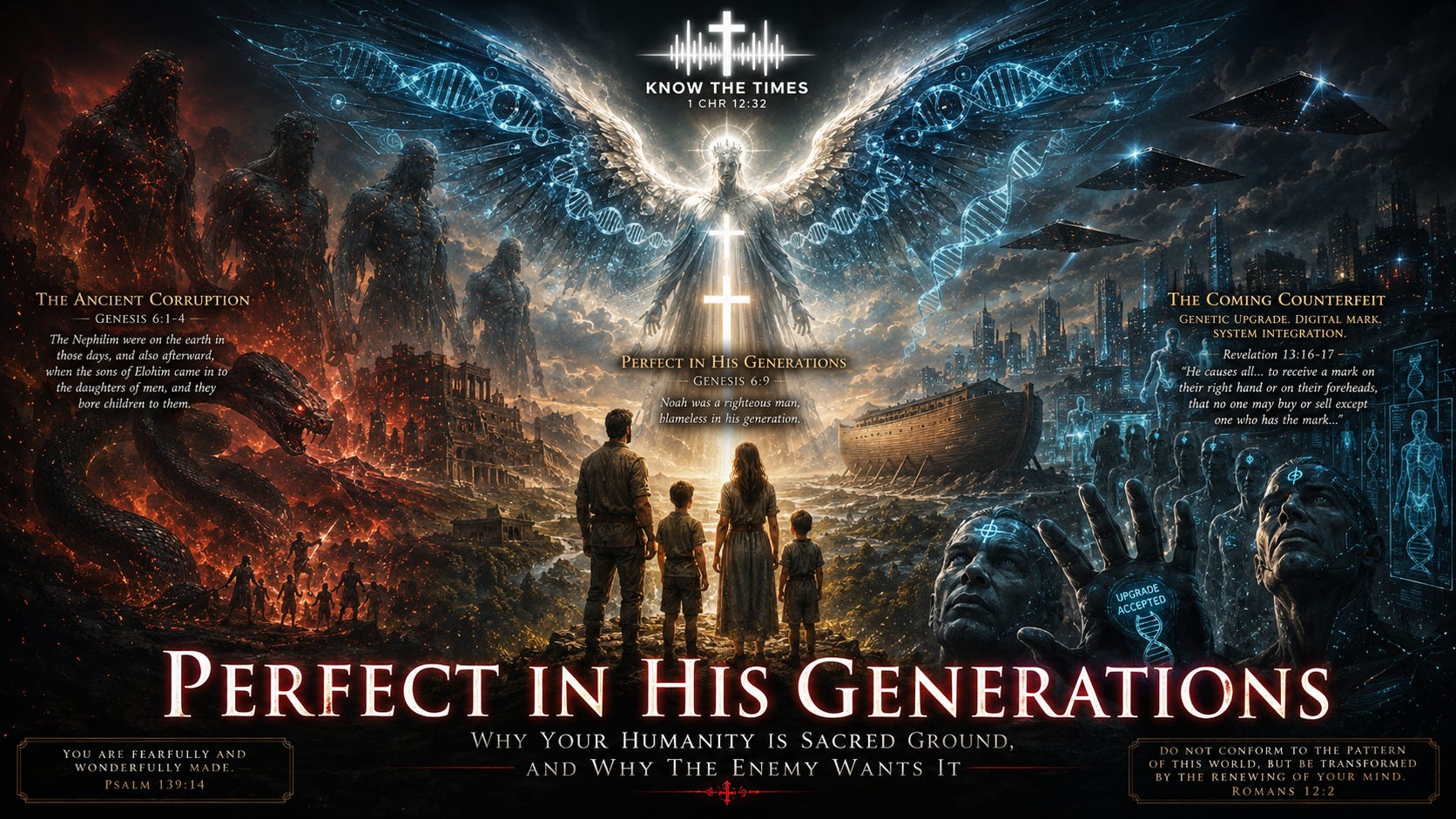
In the first article in this series, The Coming Counterfeit, we walked through the architecture of what a government disclosure of Non-Human Intelligences might look like, and more importantly, what it would mean for Christians who have not been given the theological tools to evaluate it. We established that the disclosure narrative, as it is already being shaped, is not neutral. It could have a theology of its own, where Jesus was an emissary, Scripture has been editorially revised by human hands, and a genetic upgrade is coming that will cure your diseases and integrate you into the new global system.
We noted, almost in passing, a single Hebrew word that carries enormous weight: tamim. Noah was described as perfect in his generations. Tamim, the same word used for a spotless sacrificial animal.
Without blemish.
Uncontaminated.
And we raised the question that naturally follows: if the corruption of human genetics was catastrophic enough to prompt a global flood, and if a coming modification of human genetics is connected to the most severe divine judgment in the entire canon of Scripture, what is it about human biology. About your specific, unremarkable, unenhanced humanity…
…That is so important to God?
That is the question this article is written to answer.
But before we can answer it responsibly, we need to do something the first article did not have room to do: engage honestly with the Christian arguments for the existence of extraterrestrial life. Because they are not nothing. Some of them are made by serious thinkers, grounded in legitimate theological reasoning, and they deserve a fair hearing before we explain why (regardless of whether life exists elsewhere in the cosmos) the disclosure narrative as presented is still not what it claims to be.
— — —
Part One: What Faithful Christians Have Argued About Life Beyond Earth
The question of extraterrestrial life is not a new one, and it has not been the exclusive property of secular science fiction writers. Theologians, philosophers, and serious Christian thinkers have wrestled with it for centuries. Before we can engage the disclosure moment clearly, we owe it to our readers (and to intellectual honesty) to lay out the strongest versions of the case that alien life might exist and that such existence is not necessarily incompatible with Christian faith.
The Argument from Divine Freedom and Creative Abundance
The most theologically robust argument for the possibility of extraterrestrial life is rooted not in science but in the character of God. The argument runs roughly like this: God is infinite, and His creativity is not exhausted by what we can observe. Scripture itself describes a creation of staggering scope, a universe of billions of galaxies, each containing billions of stars, the vast majority of which appears to serve no function that humans will ever directly observe or benefit from. Why would God create so extravagantly if the only creatures He intended to populate it were a small species on a pale blue dot in an unremarkable spiral arm of one ordinary galaxy?
C.S. Lewis, one of the most careful and orthodox Christian thinkers of the twentieth century, took this question seriously. In his Space Trilogy (Out of the Silent Planet, Perelandra, and That Hideous Strength) he imagined inhabited worlds with their own unfallen rational creatures, each in right relationship with God, each with their own form of worship and their own mode of bearing the image of their Creator. Lewis was careful to frame Earth (the “silent planet”) as the uniquely fallen world, quarantined from the rest of a cosmos that remained largely uncorrupted. His framework preserved the uniqueness of the Incarnation by making the redemption of Earth a specific, targeted act in a universe where not every rational species needed redemption.
Lewis was not writing theology, but his imaginative framework points toward a genuine theological possibility: that God’s creative freedom is not limited to a single inhabited world, and that the existence of other rational creatures elsewhere in the cosmos would not automatically threaten the uniqueness of Christ or the sufficiency of the Gospel.
Where Lewis’s Framework Breaks Down — and Why It Matters Now
Here is where we must press beyond Lewis, because the Disclosure scenario inverts the one assumption his framework depended on entirely. Lewis imagined unfallen creatures. He imagined beings in right relationship with their Creator, uncorrupted by rebellion, possessing no motive to deceive. The hnau of Malacandra and the inhabitants of Perelandra were transparent precisely because they had nothing to hide. Their goodness was legible. Their intentions could be read at face value.
The disclosure scenario does not give us that. It gives us beings whose nature, origin, and allegiances are entirely unverifiable by the people receiving them. And the Lewis framework (generous, imaginative, theologically careful on its own terms) provides no tools for the far more dangerous problem: what do you do when the beings in front of you present themselves as unfallen, but may not be?
This is not a hypothetical refinement. It is the central problem. Because Scripture does not merely describe a cosmos populated by unfallen rational creatures going about their business in peaceful relation with God. It describes a cosmos in which some of those creatures rebelled; and in which those rebels are characterized, above all else, by the capacity for sophisticated misrepresentation. The serpent in Eden was not obviously a serpent. He was the most subtle of all the creatures (Genesis 3:1). The rebel Watchers of Genesis 6 did not arrive announcing destruction; they arrived taking wives, embedding themselves in human civilization, presenting themselves in terms human beings could receive. Paul’s warning in 2 Corinthians 11:14 is not a general caution about being skeptical, it is a specific theological datum: Satan himself transforms into an angel of light. Deception is not incidental to his nature. It is definitional.
Now consider what a Christian who has absorbed the Lewis framework (but not thought past it) would do if beings appeared that seemed ancient, wise, benevolent, and beyond our current moral failures. The Lewis-shaped imagination says: these could be the hnau of another world, creatures God made elsewhere who remained in right relationship with Him. They are more advanced than us because they never fell. Their wisdom is genuine because it is uncorrupted. We should listen to them.
That conclusion does not follow. And the gap between “they seem unfallen” and “they are unfallen” is precisely where the deception lives. A genuinely unfallen creature from another world, if that world exists, would have no reason to redirect worship, no motive to reframe the identity of Christ, no interest in modifying human genetics, and no stake in integrating humanity into a global economic system. Goodness, in the Biblical framework, does not seek to absorb. It does not offer upgrades in exchange for allegiance. It does not require you to receive something into your body to participate in the new order.
What if, instead, the beings presenting themselves in the disclosure moment are fallen, either fallen rational creatures from elsewhere in the cosmos, or more likely, the very principalities and powers Scripture already describes: the rebel divine beings of the unseen realm who have been operating behind the veil of human history for millennia, and who are now, for reasons that Scripture suggests are connected to the end of an age, stepping into the open? In that case, the disclosure is not first contact. It is a long-prepared reveal. And the costume of the benevolent, patient, technologically advanced guide from the stars is exactly what the angel of light wears.
Lewis himself understood this danger more clearly than his admirers sometimes remember. In That Hideous Strength, the third novel of the Space Trilogy, the threat is not alien invasion but something far more insidious: a technocratic institution on Earth, the N.I.C.E., operating in service of dark eldils, fallen spiritual beings, who present their program as scientific progress and human improvement. The people implementing it are not cackling villains; most of them are sincere. They believe in the work. They have been told it will benefit humanity. Lewis’s point was that the corruption of good things (science, governance, social improvement) by powers whose nature the participants cannot discern is not a fantasy scenario. It is the normal mode of operation of the enemy.
The problem is not Lewis’s imagination. The problem is that his readers may reach for the hnau of Malacandra as a framework for evaluating the beings of the disclosure moment, without carrying forward the darker and more theologically precise warning that Lewis himself embedded in the same series. The church needs both halves of Lewis, not just the beautiful one. And it needs something Lewis’s fiction cannot ultimately provide: a Biblical epistemology for evaluating non-human intelligences that does not rely on first impressions.
John provides that epistemology in his first epistle: “Beloved, do not believe every spirit, but test the spirits, whether they are of God; because many false prophets have gone out into the world. By this you know the Spirit of God: every spirit that confesses that Jesus Christ has come in the flesh is of God, and every spirit that does not confess that Jesus Christ has come in the flesh is not of God. And this is the spirit of the Antichrist, which you have heard was coming, and is now already in the world” (1 John 4:1-3, NKJV).
Note what John does not say. He does not say: test whether they seem ancient. Test whether their technology is impressive. Test whether their intentions appear benevolent. Test whether their account of history is compelling. He says: test whether they confess that Jesus Christ has come in the flesh. That the eternal Son of God took on a genuine, biological, human body: permanently, irreversibly, as the hinge of all creation’s redemption. And that last part is important; He came, not just in human form, but as the redemptive sacrifice who made righteous all of Adam’s children. Any being that cannot make that confession, or that recontextualizes it, or that offers a more nuanced version of it, has already told you everything you need to know. Ancient wisdom, impressive technology, and a compassionate demeanor are not substitutes for that test. They are, in fact, exactly what you would expect from a being that has had millennia to study human psychology and craft a presentation accordingly.
The Argument from the Scope of the Heavenly Host
Scripture presents a cosmos that is far more populated than the typical Sunday school version of reality allows. The Divine Council framework (drawn from Deuteronomy 32:8-9, Psalm 82, Job 1-2, and 1 Kings 22) describes a heavenly assembly of divine beings, the bene ha’elohim, who serve in God’s governance of creation. Colossians 1:16 speaks of Christ as the one through whom “all things were created, both in heaven and on earth, visible and invisible, whether thrones or dominions or principalities or powers.”
If the Biblical cosmos already contains multiple orders of rational, volitional, non-human beings (and it clearly does) then the idea that God might have created other embodied rational beings in the physical universe is at least consistent with the pattern of creation Scripture already describes. The universe of the Bible is not a closed, human-only system. It has always been populated by more than we see.
The Argument from Silence and Interpretive Humility
A third argument is more modest but intellectually important: Scripture does not explicitly address the question of extraterrestrial biological life, and we should be cautious about building theological certainties on arguments from silence. The Bible is not a comprehensive cosmology. It is the account of God’s redemptive dealings with humanity, and its focus on human beings does not require the conclusion that human beings are the only creatures God has placed in the physical cosmos.
Thomas Aquinas, engaging the philosophical science of his day, argued that God’s omnipotence was not constrained by what He had actually done; that God could have made many worlds, and that the non-existence of those worlds was a matter of divine choice rather than divine limitation. Many in the medieval scholastic tradition followed a similar line. The idea that Christian orthodoxy requires a biologically empty cosmos is not a well-established historical position; it is more often an assumption that was never consciously examined.
Answering the Theological Questions from Part One
The first article posed several pointed theological questions that seem to follow from the existence of alien life. They deserve direct engagement, because if Christians cannot answer them, they will find themselves intellectually disarmed at exactly the moment when those questions are deployed against their faith.
Would other species bear the consequences of Adam’s sin? This is a genuine theological puzzle, and the most careful answer is: we do not know, because Scripture does not address it. What we do know is that Paul’s framing in Romans 8:19-22 is sweeping: “the earnest expectation of the creation eagerly waits for the revealing of the sons of God... the creation itself also will be delivered from the bondage of corruption.” The entire creation, not merely the human portion of it, is caught up in the effects of the fall and the scope of the coming redemption. If other rational creatures exist, they are not outside that cosmic frame. Whether they fell, how they fell, and what God’s remedy for them looks like are questions that Scripture simply does not answer, and that is a legitimate answer.
Would Christ need to be incarnated and crucified on every inhabited world? This question assumes more than Scripture requires. The Incarnation is presented in the New Testament as a singular, unrepeatable, once-for-all event: “But now, once at the end of the ages, He has appeared to put away sin by the sacrifice of Himself” (Hebrews 9:26). The finality of Christ’s atoning work does not require a separate Incarnation for every fallen species any more than it requires a separate Incarnation for every fallen human being. How the benefits of Christ’s work extend beyond the human race (if they do) is a question to which Scripture gives us no confident answer. But the question is not as unanswerable as it first appears, because the answer is simply: God knows, and He is not limited by our imaginations about how redemption must work.
Do we need to evangelize extraterrestrials? Almost certainly not in the way the question is usually posed, because the Great Commission is specifically directed toward “all nations”, panta ta ethne, all the peoples of the earth. It is a commission about the human race, which is the subject of Scripture’s redemptive story. Whether God has made provision for other rational creatures through means He has not revealed to us is His business, not ours. Our business is the commission we have actually been given.
The Crucial Distinction: Existence vs. Disclosure
Here is where everything turns. Grant every point of the Christian case for extraterrestrial life. Assume, for the sake of argument, that God has populated His vast creation with other rational creatures. Assume that their existence does not threaten the uniqueness of the Incarnation, does not undermine the sufficiency of Scripture for human redemption, and does not require us to rethink the basic architecture of the Gospel.
None of that validates the disclosure narrative.
Because the disclosure narrative is not merely claiming that life exists elsewhere. It is making specific theological claims: that those beings have been guiding human development, that Jesus was their emissary rather than the eternal Son of God, that Scripture has been corrupted and needs their clarification, and that they are now offering humanity an upgrade that participates in the economy of the Beast.
The existence of extraterrestrial life, even if granted on every Christian argument above, does nothing to make those claims credible. The question is not whether God could have made other creatures. The question is whether the beings presenting themselves in the disclosure moment are who they say they are, and whether the offer they are extending is what it claims to be.
On those questions, Scripture is not silent at all. And it is to those questions that we now turn.
— — —
Part Two: The Biblical Foundation — Why Your Humanity Is Sacred
Made in the Image: What the Imago Dei Actually Claims
Genesis 1:26-27 is one of the most commented-upon passages in the entire Bible, and one of the most casually misunderstood. “Then God said, ‘Let Us make man in Our image, according to Our likeness’... So God created man in His own image; in the image of God He created him; male and female He created them.”
The Hebrew word translated as “image” is tselem (צֶלֶם), and its counterpart “likeness” is demuth (דְמוּת). In the ancient Near Eastern world, tselem carried significant freight: it was the word used for a cultic statue; the physical representation of a deity placed in a temple to mark that deity’s presence and authority in that territory. When a king conquered a region, he erected a tselem of himself. It was a claim of ownership and a declaration of presence.
When God places human beings into creation as His tselem, He is not merely saying that humans are His favorite creatures or that they have advanced cognitive abilities. He is making a territorial and relational claim: these beings are My representation in this space. They carry My authority. They bear My likeness. Where they are, I am present.
This is not a metaphor about having a conscience or the capacity for language. It is an ontological statement about what a human being is in the cosmic order. The image of God is not an attribute that humans have; it is what humans are. And it has an enemy.
The Cosmic Conflict and the Target
To understand why the imago Dei is a target, you have to understand the conflict that Scripture describes. A conflict that most Western Christianity has flattened into a simple morality tale of individual sin and forgiveness, but which the Biblical text presents as something far more cosmic and structural.
The Divine Council framework, drawn from Deuteronomy 32:8-9, Psalm 82, Job 1-2, and Psalm 89, presents a picture of a heavenly assembly of divine beings over which God presides. In Deuteronomy 32:8, following the Septuagint and Dead Sea Scrolls manuscript tradition which read “sons of God” rather than “sons of Israel,” the nations are allotted to the divine sons of God at Babel. Israel alone is reserved as God’s own portion. This is not primitive mythology; it is the cosmic geography that underlies the entire Old Testament narrative.
Some of those divine beings rebelled. Psalm 82 records God’s judgment on the elohim of the divine council who have “judged unjustly” and shown “partiality to the wicked.” The Watchers of Genesis 6 represent a specific and catastrophic instance of this rebellion, one that targeted the imago Dei directly. The bene ha’elohim took human women and produced the Nephilim: creatures that were neither fully human nor fully divine, but something aberrant that did not belong to the order God had created.
This was not random. It was strategic. If the image of God in humanity could be diluted, defiled, or destroyed, the carrier of God’s presence and authority in the material world would be compromised. The cosmic battle is not merely about who goes to heaven. It has always been about whose image marks the earth.
The Flood as Surgical Preservation
Read with that lens, the Genesis 6-9 flood account looks different than the morality tale it is often reduced to. It is not merely a story about God punishing wicked people. It is a story about God surgically preserving the one genetic line through which His redemptive plan could be carried forward.
The word shachath (שָחַת), translated as “corrupt” in Genesis 6:11-12, means to ruin, to destroy, to render irreparably broken. It is the same word used for what happens to a garment that cannot be cleaned. The corruption was not merely moral, though it was certainly that. The text presents a world in which the physical integrity of humanity had been so thoroughly compromised that the project of bearing the image of God was in danger of extinction.
Noah was tamim (תָּמִים) in his generations. His line was intact. And from that line — through Shem, through Abraham, through the tribe of Judah, through the house of David, would come the One whose body would be the instrument of the world’s redemption.
This is why genealogies matter in Scripture. Modern readers skip them. Ancient readers understood them as the spine of the entire narrative. Every “begat” in Matthew 1 is a data point in the chain of custody of the uncorrupted human line, the line that terminates in the womb of Mary and produces the body in which the eternal Son of God takes on flesh. The Incarnation required an uncorrupted human nature. The surgical preservation of Noah’s line was, in the eternal plan of God, the preservation of the body of Christ.
The Resurrection Body: God’s Answer to Every Upgrade Offer
Now move forward from the manger to the garden tomb and consider what came out.
The resurrection body of Jesus Christ is the most important piece of information in all of Christian theology: more than the virgin birth, more than the miracles, more even than the cross, because the cross without the resurrection is merely a tragedy. But what kind of body walked out of that tomb?
It was physical. Thomas touched the wounds (John 20:27). Jesus ate fish with the disciples on the shore of Galilee (John 21:9-13). It was not a ghost, not a vision, not a spiritual projection. But it was also transformed. The resurrection body moved through locked doors (John 20:19). It was not always immediately recognizable (Luke 24:16). Paul labors over this in 1 Corinthians 15:42-44: “It is sown in corruption, it is raised in incorruption. It is sown in dishonor, it is raised in glory. It is sown in weakness, it is raised in power.”
The trajectory of the human body in God’s redemptive plan is not abolition. It is not transcendence in the sense of leaving the body behind. It is glorification — a transformation of the same material into something that was always its intended final state. The body is not a problem to be solved. It is a creation of God that will be raised, restored, and glorified when all things are made new.
God’s upgrade for the human body is the resurrection. He has already announced it, already demonstrated it in Christ, and already secured it for all who are in Him. Any competing offer of enhancement or upgrade is not a supplement to that plan. It is a counterfeit of it.
— — —
Part Three: The Transhumanist Application
What Transhumanism Actually Is
Transhumanism is a philosophical and technological movement that holds that the human condition can and should be fundamentally transformed through the application of technology: genetic engineering, neural interfaces, artificial intelligence integration, and biotechnology. Its adherents, who include some of the most influential and well-funded technologists and academics in the world, argue that aging is a disease to be cured, that cognitive and physical limitations are engineering problems to be solved, and that the boundary between human and machine is an arbitrary line that human progress will eventually erase.
Prominent voices include Ray Kurzweil, whose concept of the Singularity envisions a merger of human and artificial intelligence within this generation; Yuval Noah Harari, whose books have reached audiences of tens of millions with the argument that Homo sapiens is on the verge of upgrading into something qualitatively different; and a growing ecosystem of researchers at institutions like Oxford’s Future of Humanity Institute who treat the enhancement of human capabilities as an unambiguous moral good.
This is not fringe speculation. It is the direction of travel of the most powerful technological and economic institutions on earth, and it has an explicit theological dimension, whether its proponents acknowledge it or not.
The Oldest Offer in the World
“You will be like God.”
The serpent’s offer in Genesis 3:5 was not primarily about the fruit. The fruit was the vehicle. The offer was ontological elevation, a shortcut to a higher mode of being, available now, without waiting for God’s timing or trusting God’s process. It was an offer to transcend the limitations of creatureliness. The transhumanist offer is structurally identical. The language has been updated. We speak now of optimizing rather than enlightening, of genetic enhancement rather than forbidden knowledge, but the bones of the offer are the same: you are limited in ways you need not remain limited, and we can fix that for you.
What was true in Eden remains true now: the offer comes packaged as liberation. It arrives dressed as benevolence. The beings extending it present themselves as guides who want only humanity’s flourishing. Christians should be very slow to assume that any offer framed this way is innocent.
The Convergence: When Disclosure Meets Transhumanism
Here is where we must be most alert, because this is where the two narratives, UAP disclosure and transhumanist enhancement, are likely to merge into something more powerful than either alone.
Imagine the disclosure narrative we outlined in Part One of this series, now combined with a concrete technological offer. Non-Human Intelligences have been guiding humanity toward this moment. They have watched us suffer from disease, from aging, from cognitive limitation. They have a gift: a biological modification that will address these limitations. It is safe. It has been tested across thousands of years of observation. And as a practical matter, it integrates with the new global infrastructure that is already being built.
No mark, no buying, no selling (Revelation 13:17).
The theological warning of Revelation 14 is not that the Mark of the Beast is a sin like other sins, something to be confessed and forgiven. The warning is categorical and without exception. Why? Because if what we have argued in this article is correct, that the image of God in humanity is an ontological reality, that the preservation of an uncontaminated human nature was the scaffolding upon which the entire redemptive plan was built, that the resurrection body is God’s own declared trajectory for human embodiment; then an irreversible modification of human biological identity is not merely a bad decision. It is the voluntary surrender of the very thing that makes a human being capable of receiving the redemption that God, at immense cost, has made available.
The pattern is not a coincidence. It is a warning written into the structure of the entire Biblical narrative, from Genesis 6 to Revelation 14, and it deserves to be read as such.
The Manipulation of Compassion
We must address something that sophisticated Christians may stumble over, because the enemy will use it: compassion. The genetic upgrade will be offered first to the suffering. To children with degenerative diseases. To the elderly. To people whose conditions cannot be treated by existing medicine. The framing will be humanitarian, and the people offering it will not be twirling mustaches. They will be sincere. They will weep with the families of the sick.
This is by design. Paul warns in 2 Corinthians 11:14 that Satan transforms himself into an angel of light. The most effective deceptions are not the ones that look evil. They are the ones that look like mercy. The love of parents for sick children is one of the most powerful forces in human experience. If the offer can be made first to the most sympathetic recipients, the social pressure on everyone else to follow will be enormous.
This is not an argument against compassion. It is an argument that compassion, however sincere, is not sufficient as a theological method. We need more than feeling to navigate what is coming. We need the word of God, rightly handled, deeply understood, and held with both hands. And we need to trust in the conviction the Holy Spirit brings when we sincerely seek His guidance.
The Body as Testimony
Your unenhanced, unmodified, unremarkable human body is a theological statement.
In a culture that views the human body as a platform, something to be optimized, upgraded, customized, and eventually transcended, the Christian confession is that the body is a creation of God that will be raised from the dead. It is not a cage for the soul. It is not a meat suit. It is you. And God intends to glorify it.
The willingness to remain human (to decline the offer of a technological transcendence that bypasses resurrection, to live within the limits of created embodiment and trust God’s declared plan for what comes next) is not a failure of ambition. It is an act of faith. It is the confession, made in flesh, that the resurrection of Jesus Christ was not a metaphor and that the promise attached to it is real.
Paul’s articulation of this in Philippians 3:20-21 is worth sitting with: “For our citizenship is in heaven, from which we also eagerly wait for the Savior, the Lord Jesus Christ, who will transform our lowly body that it may be conformed to His glorious body, according to the working by which He is able even to subdue all things to Himself.”
The transformation is coming. God has promised it. The One who secured it is coming back to deliver it. No laboratory, no alien emissary, no benevolent NHI civilization with a genetic gift can give you what God has already purchased for you at the cost of His own blood. Do not sell that birthright for anything.
— — —
Conclusion: Standing Firm in the Skin You’re In
We have covered significant ground in this article, and it is worth gathering the threads before we close.
First: the Christian case for the existence of extraterrestrial life is not absurd. Serious, orthodox thinkers from C.S. Lewis to Thomas Aquinas have acknowledged that God’s creative freedom is not exhausted by what we can observe, that Scripture does not explicitly rule out other rational creatures, and that the existence of such creatures would not automatically collapse the uniqueness of the Incarnation or the sufficiency of the Gospel. The theological questions raised by the existence of alien life are hard, but they are not unanswerable, and Christians should not be caught flat-footed by them.
Second: none of that validates the disclosure narrative. The existence of extraterrestrial life, even granted on every Christian argument, does nothing to substantiate the specific claims that are being built into the disclosure moment — that Jesus was an emissary of an interstellar civilization, that Scripture requires their clarification, and that the genetic upgrade they are offering is humanity’s next step forward. Those claims stand or fall on their own merits, and on every point where Scripture speaks clearly, they fall.
Third: the theology of the human body is not incidental to the Gospel. It is load-bearing. The imago Dei is not a metaphor; it is an ontological reality and a cosmic territorial claim. The corruption of that image was catastrophic enough to prompt a flood. Its preservation through Noah was the preservation of the Messianic line. The Incarnation required a genuinely, fully human nature. The resurrection body of Christ is the prototype for the glorified humanity that God has declared as the endpoint of redemption. Every link in that chain matters, and an offer that tampers with human biology is not engaging with a peripheral issue. It is targeting the center.
Fourth: the enemy is patient, intelligent, and has been working this plan for a very long time. The disclosure narrative has not been assembled carelessly. It is built to absorb Christianity rather than attack it, to recontextualize Christ rather than deny Him, to appeal to the best instincts of compassionate people rather than the worst. The church needs to think carefully now, not after the press conference.
We believe that God made us in His image and that image is not a defect to be corrected. We believe that Jesus Christ took on our nature permanently and that the resurrection body He carried out of the tomb is the prototype for what awaits every person who is in Him. We believe that the same powers that corrupted human genetics in Genesis 6 are active in the world now, working toward the same end by different means.
And we believe that when the offer comes, packaged beautifully, presented compassionately, backed by signs and wonders we cannot immediately explain, the answer is the same one the three Hebrew men gave in the plain of Dura when the music played and everyone else bowed:
“Our God whom we serve is able to deliver us from the burning fiery furnace, and He will deliver us from your hand, O king. But if not, let it be known to you, O king, that we do not serve your gods, nor will we worship the gold image which you have set up.” (Daniel 3:17-18, NKJV)
But if not. That is the posture of people who trust God more than they fear the furnace. That is the theological backbone the church needs to be building right now, in the years before the music starts.
Stay human. Stay His.
In each post there’s always the opportunity to subscribe for a free or paid subscription…
…but I know that a paid subscription may be a big ask in today’s economy so I also wanted to give you the opportunity to give a one-time gift to support this ministry. So if you don’t want to commit to a monthly or yearly gift of support but you still feel you have been blessed by something I’ve done here, I’ve come up with a new way to give a one-time gift of any amount. Just click the link below (or scan the QR code and you’ll be taken to the page for Know the Times).

And, as always, feel free to share this article with someone you feel may be blessed by it.