

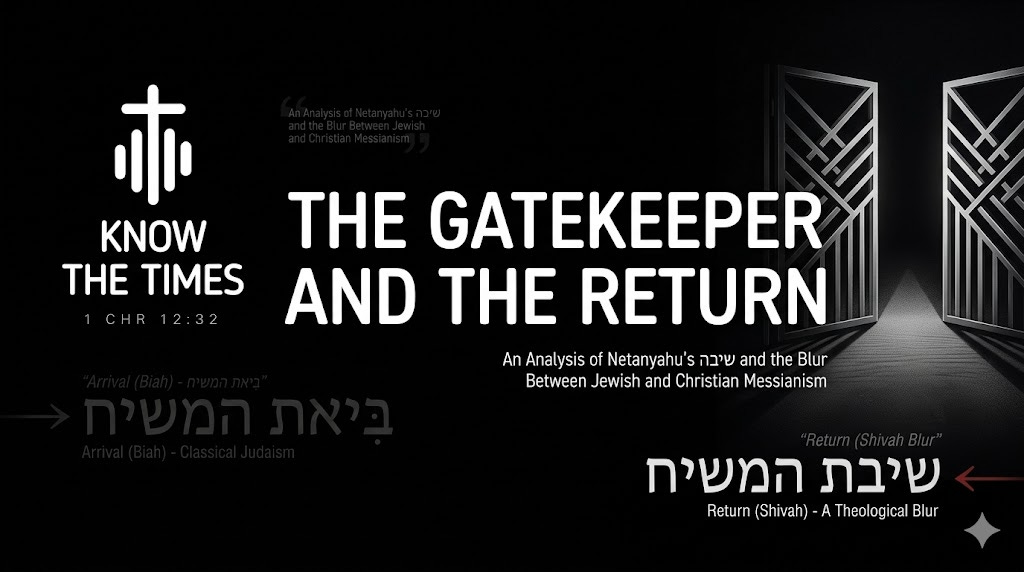
The Gatekeeper and the Return
An Analysis of Netanyahu's שִיבה and the Blur Between Jewish and Christian Messianism
Starting Where I Stand
Let me be transparent about my vantage point, because in a conversation like this one, where we are, theologically speaking, shapes what we hear. I am a Christian. I believe that Jesus (Yeshua) of Nazareth was and is the Messiah, the anointed one promised throughout the Hebrew prophets, born in Bethlehem, crucified under Pontius Pilate, and raised from the dead. I believe he has already come.
What that means for everything that follows is this: from where I stand, the next appearance of the Messiah cannot logically be a “first arrival.” It must, by definition, be a return. And that makes a single word used by Benjamin Netanyahu in March 2026 far more interesting to me than it might be to a secular analyst, and far more theologically charged than most commentators appear to have registered.
The word is שִיבה (shivah). Return. And Netanyahu chose it deliberately.
The Word That Shouldn’t Exist — In Judaism
Here is what makes Netanyahu’s choice linguistically extraordinary. In mainstream Jewish theology and liturgy, the standard phrase for the Messiah’s appearance is בִּיאת המשִׁיח (Biat HaMashiach): the coming, or arrival, of the Messiah. This is the formulation Maimonides used in the Twelfth of his Thirteen Principles of Faith: “I believe with complete faith in the coming of the Messiah.” The Hebrew word is biah: forward-looking, first-time, anticipating someone who has never appeared before in his messianic role.
Shivah means something categorically different. It means return. It implies a homecoming; a restoration of a presence that was once known and has been absent. In Zionist history, the word carries enormous weight through Shivat Tzion, the Return to Zion. But applied to the Messiah in normative Jewish usage, shivah is virtually without precedent. Why? Because in classical Jewish theology, the Messiah has not been here before. He has not yet come. So how can he return?
The answer, of course (and the answer that makes a Christian reader’s eyebrow rise) is that you can only speak of a return if you believe someone has already been here. And I do believe that. The question is whether Netanyahu does, or whether he was speaking to those who do, or whether he was doing something else entirely.
In the Hebrew transcript of his March 7, 2026 address, what he called the “War of Redemption” speech, Netanyahu said: “מכינים את הקרקע לשיבת המשיח” (preparing the ground for the return of the Messiah). And his own Prime Minister’s Office, in the English translation released to international media, did not soften shivah to “arrival” or “coming.” They kept the word “return.” That is a choice. It tells us something.
A Christian Reads the Linguistic Map
From a Christian perspective, the theology of return is not exotic or controversial — it is foundational. The New Testament closes with it. “Surely I am coming soon,” says Christ in the final verses of Revelation. “Amen. Come, Lord Jesus.” The Greek word translated “come” there is erchomai, a word of motion, of approach, of arrival. But the broader New Testament eschatological tradition builds its anticipation of Christ’s return on a different and more technical term: parousia, meaning presence or royal arrival. It appears in Matthew 24:27, in Paul’s first letter to the Thessalonians (4:15–17), in James 5:7–8, and elsewhere, and it carries the weight of an awaited, transformative appearing. The two words are not interchangeable, but they point toward the same event: in Christian eschatology, the Second Coming is not an arrival of someone new but the return of someone known, someone who has died and risen and ascended and promised to come back. The shape of the story requires a return.
So when Netanyahu chose the word shivah rather than biah, he was, whether consciously or not, using the linguistic structure of Christian eschatology rather than classical Jewish expectation. He was framing the Messiah as one who returns; which means, in the logic of that framing, as one who has already been. That is a statement that mainstream Judaism has been careful to avoid making for two thousand years, precisely because it is the statement Christianity makes about Jesus.
This does not mean Netanyahu was endorsing Christianity. But it does mean he was, at minimum, speaking a language that resonates deeply with Christians (and speaking it from a podium representing the Jewish state).
That is remarkable, however you interpret his intent.
The False Messiah Question
If you accept the Christian premise (that Jesus was the Messiah, and that he has already come) then the logic of Netanyahu’s statement creates an uncomfortable fork in the road. Either the Messiah whose return he is preparing the ground for is Jesus of Nazareth, or it is someone else. And if it is someone else presenting himself as the returning Messiah, then the Christian tradition has a very specific word for that figure: a false messiah, or in its most eschatologically charged form, the Antichrist.
I want to be careful here. I am not suggesting Netanyahu is preparing the ground for the Antichrist. I am not claiming prophetic knowledge of what he intends. What I am doing is tracing the theological logic of the language he chose, because that logic leads somewhere, and it is worth following it honestly.
The New Testament warns repeatedly about figures who will come claiming messianic identity. In Matthew 24 (v.5), Jesus himself says: “Many will come in my name, saying, ‘I am the Christ,’ and they will lead many astray.” John’s first epistle speaks of antichrists as those who deny the Father and the Son (1 John 2:22). And Paul, in 2 Thessalonians, describes a “man of lawlessness” who takes his seat in the Temple and proclaims himself God (2 Thess 2:4), a vision deeply tied, in Christian interpretation, to Jerusalem and to a political-religious figure who commands messianic authority.
Now: is Netanyahu “preparing the ground” for such a figure? Almost certainly not in the way he intends it. But what he is doing (using the language of messianic return, embedding it in state rhetoric, framing a military and political operation as the preparation for a divine event) creates a theological environment in which the arrival of a charismatic figure claiming messianic identity would find the cultural soil already tilled. That is worth paying attention to, regardless of whether you take Netanyahu’s sincerity at face value.
What Jewish Tradition Actually Says About “Return”
To be fair to the full picture, there are corners of Jewish tradition where the word shivah, or the concept of return, does approach the messianic. The Talmud in Megillah 29a teaches that the Shekhinah (God’s presence) went into exile with the Jewish people and will return with them to Zion. The return of the Divine Presence is a deeply rooted Jewish hope, distinct from, but woven together with, the coming of the Messiah. Netanyahu may be drawing on this thread: the Messiah’s return as the return of the Shekhinah to the Temple Mount, the final act of a restoration that began with Zionism.
There is also a more specific and politically important exception: the messianic wing of Chabad-Lubavitch. Followers who believe that the late Lubavitcher Rebbe, Rabbi Menachem Mendel Schneerson, is the Messiah do use the language of return, because in their theology the Rebbe did not truly die but is “concealed,” awaiting revelation and return. This is a significant community in Israeli politics, and Netanyahu has deep ties to it.
The scholar Alan Segal, in his landmark work Two Powers in Heaven, documented how Second Temple Judaism (the Judaism of Jesus’s era) often entertained the concept of a quasi-divine “principal agent” who bore God’s name and acted on his behalf. This “second power” framework was later suppressed by Rabbinic Judaism precisely because Christianity had developed it into a full theology of divine incarnation. By using the language of return, Netanyahu reaches back behind that suppression to older, more fluid messianic categories. A Christian reading this might say: yes, that is exactly where the story of Jesus stands, in the tradition that the Rabbis tried to close.
The Rebbe, the Keys, and a Prophecy Worth Taking Seriously
One of the most striking pieces of this story is a well-documented exchange between Netanyahu and the Lubavitcher Rebbe. The two men met on several occasions in the late 1980s and early 1990s, and the Rebbe reportedly told Netanyahu (with Rabbi David Nachshon present) that he would one day “hand the keys over to Moshiach.” A separate Kabbalistic tradition, attributed to the elderly Sephardic mystic Rabbi Yitzchak Kaduri before his death in 2006, held that Netanyahu would serve as prime minister for a very long time, after which the Messiah would arrive.
These are not fringe claims. They are documented in religious press, circulated in serious Chabad circles, and Netanyahu himself has publicly acknowledged the depth of the Rebbe’s influence on his life and thinking. In a 2009 address in New York, he spoke movingly of that influence.
From a Christian vantage point, this “handing over the keys” imagery lands with particular weight. In Matthew 16:19, Jesus tells Peter: “I will give you the keys of the kingdom of heaven.” The metaphor of keys, authority, and transfer is deeply embedded in the Christian messianic imagination. Whether Netanyahu is consciously invoking this or not, he is participating in a symbolic economy that Christians have been reading for two millennia. He is positioning himself not merely as a politician but as a threshold figure: a gatekeeper who prepares the way and then yields to the one who comes after. Even if all of this is happening subconsciously in the mind of Netanyahu, Chabad Jews, or Christians.
Some within Israel have even argued, as reported by Breaking Israel News (now called Israel365 News) citing Rabbi Levi Sudri, that Netanyahu fulfills the role of Moshiach ben Yosef: the practical, nation-gathering messiah who precedes and prepares the way for Moshiach ben David, the transcendent redeemer. This two-phase messianic framework, drawn from Kabbalistic tradition, maps onto Christian eschatology in interesting ways, though the identities assigned to each phase diverge sharply.
Four Ways to Read the Same Two Words
If we take Netanyahu’s use of Shivat HaMashiach seriously, four interpretive frameworks present themselves, each pointing to a different audience and a different intent.
The Chabad-Messianic Reading. Netanyahu signals to the messianic Chabad community (which he has close ties to) that he accepts their framework: the Rebbe is the Messiah, he is concealed, and his return is imminent. The word shivah is their code word, and Netanyahu speaks it. Under this reading, he is the last secular bridge before the Rebbe’s re-revelation.
The Redemptive Zionist Reading. Netanyahu synthesizes the Return to Zion with the Return of the Divine Presence. The Messiah’s return is not a person arriving but a cosmic state of restoration being achieved through the military and political acts of the modern state. The War of Redemption is the final stage of Shivat Tzion.
The Christian-Adjacent Reading. This is where it gets interesting for me as a Christian reader. By using shivah and allowing the English translation to stand as “return,” Netanyahu speaks directly to the tens of millions of Evangelical Christians (particularly in the United States) who are his most reliable international allies. For them, “the Messiah’s return” means one thing only. It means Jesus. Whether or not Netanyahu intended this meaning, he lit a signal fire in their direction, and they saw it. For real, I’ve been seeing people going on and on about this specific wording.
The Pragmatist Reading. Under this framework, no sincere belief is required at all. Netanyahu is a politician in legal jeopardy, facing elections in late 2026 he may not survive, leading a coalition held together by theological maximalists, and dependent on Evangelical American support for diplomatic cover. The word shivah costs him nothing to say and buys him everything. Chabad hears one thing. Religious Zionists hear another. Evangelicals hear a third. None of them hear the same thing. All of them feel seen.
The Political Architecture of Prophetic Language
The political utility of Netanyahu’s messianic language is inseparable from his personal circumstances. He faces corruption charges in three separate cases (bribery, fraud, and breach of trust) and has made an unprecedented pre-conviction pardon request to Israeli President Isaac Herzog, arguing that the “national interest” during the War of Redemption requires it. President Trump lobbied publicly for the pardon, and the Justice Ministry’s Pardons Department advised against it. The pardon remains unresolved.
His brother-in-law Hagai Ben-Artzi, a Bible scholar, has stated publicly (as reported by Israel Today) that “only the Messiah” can replace Benjamin Netanyahu. This is extraordinary language in a democratic context. It was dismissed by many as rhetorical excess. But read alongside a Prime Minister who uses the phrase Shivat HaMashiach in state addresses (and has had a messianic figure speak over him that he would be the lats PM before the coming of the messiah), it reveals a coherent narrative architecture: Netanyahu’s tenure is not a political appointment subject to democratic replacement, but a prophetic appointment that must run until God decides otherwise.
Netanyahu has stated that elections are “the last thing Israel needs” during the current conflict. The Israel Democracy Institute found in late 2025 that only 22.5% of Israelis were certain their upcoming elections would be free and fair. Critics at Chatham House and among the Israeli opposition have described a systematic dismantling of checks and balances. The judicial overhaul of 2023, the suppression of a State Commission of Inquiry into the October 7 failures, the framing of all legal opposition as a “deep state” conspiracy. These are not isolated events, they are the building blocks of a leader who intends to stay.
From a Christian perspective, this pattern invites serious scrutiny. History is littered with leaders who claimed divine appointment to justify earthly permanence. The language of sacred mission and political self-preservation have a long and unhappy relationship. I do not claim to know Netanyahu’s heart, but the structure of what he is building (a state in which democratic transitions feel like interruptions of prophecy) is a structure that should alarm anyone who takes seriously the warning that the road to false messianism is paved with sincere-sounding religious conviction.
The Pushback, and What It Tells Us
Not everyone in Israel heard Netanyahu’s language approvingly. Segments of the Haredi (ultra-Orthodox) world, particularly the Lithuanian non-Hasidic tradition with its deep roots in Maimonidean rationalism, reacted sharply. Publications like Yated Ne’eman have historically guarded the term Biat HaMashiach as a theological boundary marker, and the substitution of shivah was heard as a “pollution” of Jewish language with Christian conceptions of a Second Coming. The objection is precise: to say the Messiah “returns” implies he has been here before. That implication is exactly what Judaism has spent two millennia refusing, because it is the implication on which Christianity was built.
Secular Israeli commentators used language like “Messianic Nationalism” and warned in publications like Haaretz that Netanyahu was replacing rational statecraft with apocalyptic expectation. The Israeli opposition framed the messianic rhetoric as evidence of anti-democratic intent: if the leader is divinely irreplaceable, elections become sacrilege.
These criticisms come from opposite directions (Orthodox Jews who feel their theology is being hijacked, and secular democrats who feel their institutions are being mystified) but they converge on the same concern. Netanyahu has introduced a category of authority that democratic systems have no tools to contest. You cannot vote against a prophetic mandate. You cannot cross-examine a Rebbe’s blessing. You cannot subject the “War of Redemption” to a State Commission of Inquiry.
A Christian’s Honest Reckoning
I want to sit with the discomfort this analysis produces, because I think it is the honest place to end.
As a Christian, I am aware that Evangelical support for Israel is often framed (sometimes honestly, sometimes cynically) in terms of biblical prophecy. Many of my brothers and sisters in Messiah believe that the regathering of the Jewish people in the land of Israel is a necessary precondition for Christ’s return. Some believe the rebuilding of the Temple is required. Some support Israeli military action in the region because they believe it hastens an eschatological timeline. Netanyahu knows this. His team knows this. The word “return” in his English-language press release was not accidental. He was speaking to us.
I find this worth examining carefully. There is a difference between supporting Israel because one believes in justice, peace, and the security of a people who have suffered enormously throughout history, and supporting a particular Israeli government’s policies because one believes doing so will trigger a divine countdown. The first seems to me a reasonable expression of Christian commitment to human dignity and solidarity with the Jewish people from whom our faith springs. The second carries risks that I think Christians have not adequately grappled with.
If Netanyahu is playing to the Evangelical gallery (which the evidence suggests he is, at minimum) then Christians who respond to that play without reflection are potentially allowing a politician’s survival strategy to shape their theology, rather than allowing their theology to shape their political discernment. The trumpet can be blown by someone who knows perfectly well it is a trumpet, and who has no particular interest in what comes after the noise.
And if he is sincere – if Netanyahu genuinely believes he is the Gatekeeper preparing the way for a messianic return – then Christians should ask, with equal seriousness, which Messiah he is preparing the way for. Because from where I stand, there is only one person that answer can point to, and it is not the Lubavitcher Rebbe, and it is not a figure who has never yet appeared, and it is not a geopolitical construct. It is a man who was crucified outside Jerusalem two thousand years ago and who said he would come back.
Whether Netanyahu is an unwitting herald, a strategic opportunist, or a genuine believer in a particular strand of Jewish eschatology, the word he chose (shivah, return) has crossed a theological boundary that two millennia of careful Jewish and Christian distinction had maintained. That boundary is now blurred, in the speech of a sitting head of state, at a moment of extraordinary regional violence and political instability. The word landed. We should think carefully about what it means that it did.
Conclusion: The Gatekeeper and the Gate
Benjamin Netanyahu did not say the Messiah is coming. He said the Messiah is returning. That single syllable of difference (shivah rather than biah) is not a slip. It is a window into the multiple theological worlds he is simultaneously addressing, and perhaps into the world he himself inhabits.
For Jewish critics, it represents a dangerous blurring of the boundary between Jewish and Christian messianism. For secular democrats, it represents the sacralization of a political tenure that should be subject to ordinary accountability. For pragmatic analysts, it represents a masterclass in what might be called Dog Whistle Theology: a single word that means everything to everyone and commits its speaker to nothing.
For me, as a Christian, it represents something more unsettling and more interesting than any of those readings alone. It represents a moment in which the language of Return, the language that sits at the heart of Christian hope, was deployed by a politically embattled prime minister in the context of a war he calls Redemption, in a city where two great religious traditions and one living hope all claim the same ground.
I do not know what Netanyahu believes. I am not sure he always knows either. But I know this: when a leader positions himself as the Gatekeeper of the Messiah’s return, the most important question is not whether he is a cynical politician or a sincere believer. It is: whose return? That question has an answer. And it is an answer that cuts through every political calculation, every coalition negotiation, every pardon request, and every carefully translated press release.
Come, Lord Jesus. But let us be wise about who is holding the gate in the meantime.
I thank you for bringing this out as I had not heard of him saying this. Very very interesting!!
It was wild! I heard it and I had to look at the language!