

Water Under Siege
The Attacks are Spreading. Are you Prepared?
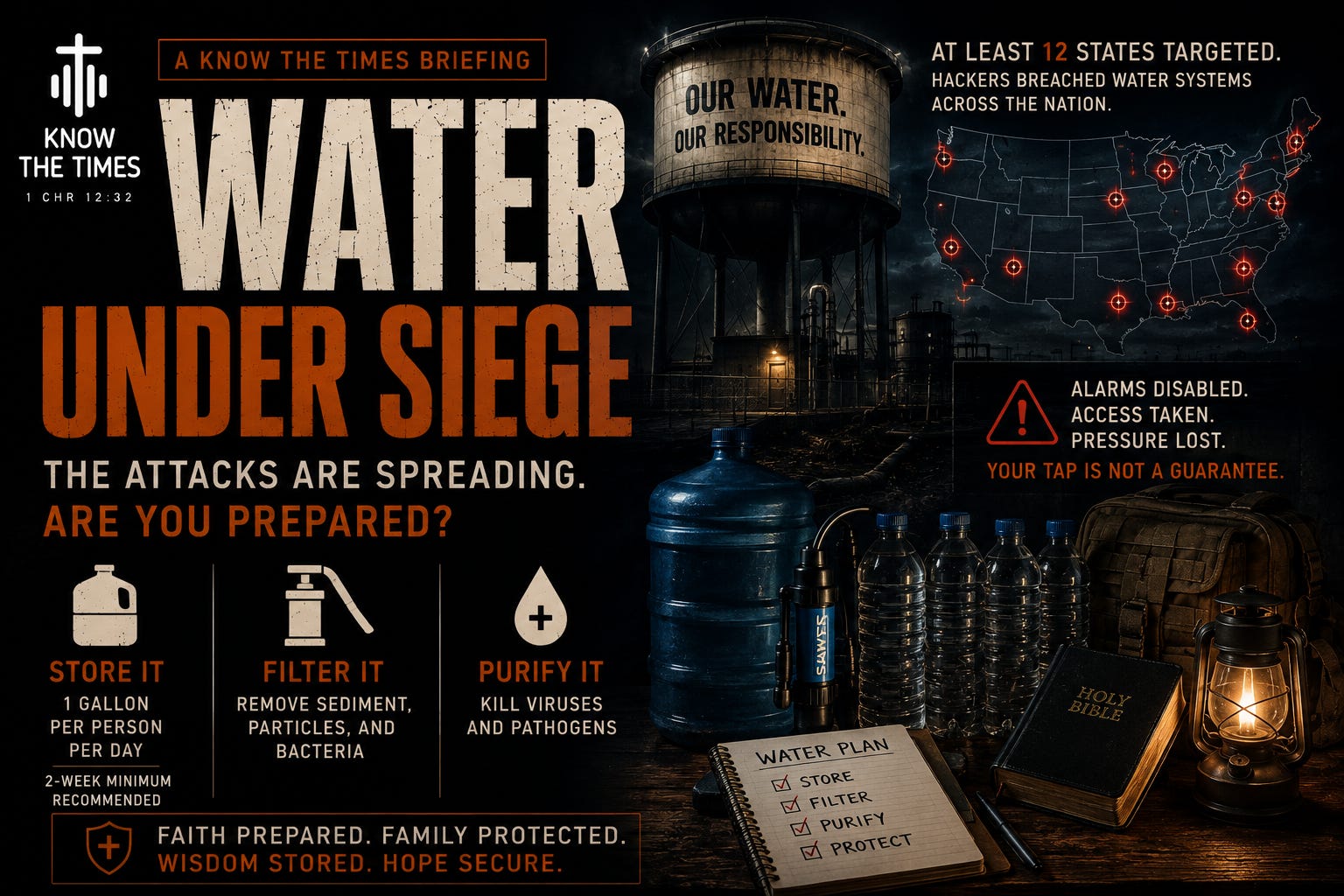
Last week this briefing covered a cyberattack on municipal water systems that federal agencies had confirmed in at least seven states. That number is already out of date. It is now at least twelve, and there is good reason to believe it will keep climbing before this story is finished.
The Story Has Grown
At least a dozen states have now reported intrusions into water and wastewater operational systems. Minnesota remains the largest confirmed case, with more than thirty community water systems targeted in a single weekend. Michigan has confirmed that nine communities saw malicious activity, though operators kept those systems running safely. At least one city in South Dakota has reported an intrusion that appears to be part of the same campaign, and the Clayton County Water Authority in Georgia confirmed a temporary disruption that reduced water pressure in some areas before service was restored within hours.
The tactics being reported are also more specific now than they were a week ago. Beyond simply changing passwords and IP addresses, some of these intrusions reportedly disabled safety alarms, the systems that alert a human operator when something in the treatment process has gone wrong. That is a meaningfully different kind of danger. A locked-out password is an inconvenience. A disabled alarm means an operator may not know there is a problem until someone downstream notices the water looks or tastes wrong.
Attribution has grown murkier rather than clearer. Multiple outlets continue to report that Iran is the leading suspect, but on Friday President Trump told reporters he does not believe there was an Iranian cyberattack at all, directly contradicting the working theory several federal sources have described. Whatever the truth turns out to be, and it may take months for investigators to settle it, the practical takeaway from last week’s briefing stands: the people filling boil water notices at the kitchen counter are not waiting on an attribution report to know their tap water has become a question mark rather than a certainty.
You cannot control who is behind the keyboard. You can control whether your household has water on the day the tap gives you a reason to doubt it.
There is also a structural reason this keeps happening that deserves more attention than it usually gets. Unlike the electric grid, most water utilities in America are run directly by local governments, where a cybersecurity upgrade has to compete for the same limited budget as schools, roads, and everything else a small town needs. That is not a partisan observation. It is simply how municipal budgets work, and it means the vulnerability being exploited here is not going away when this particular news cycle does.
Which brings us to the actual purpose of this briefing. Not another update on who did what to whom, but a real plan for making sure your household’s water supply does not depend on any of it.
The Three-Layer Water Plan
A sound water preparedness plan rests on three layers, and each one covers a different failure. Storage covers the gap between when the water stops and when it starts again. Filtration removes particles, sediment, and biological contaminants from water you find or collect. Purification, often used alongside filtration, kills or deactivates pathogens that a filter’s pores are too large to catch, most importantly viruses. You want at least a basic version of all three, not just one.
Layer One: Storage
The standard guidance from FEMA and the Red Cross is one gallon per person per day, covering both drinking and basic hygiene, with a minimum two-week supply as the target for a serious household plan. For a family of four, that is a floor of fifty-six gallons. Round up if you have pets, a nursing mother, a medically fragile family member, or a hot climate, since needs rise quickly under any of those conditions.
Budget tier
Start with what you already have. Clean, food-grade juice or cider jugs work well and cost nothing; never reuse plastic milk jugs, since they are not designed for long-term storage and break down faster. A couple of 7-gallon rigid jerry cans (the Reliance Aqua-Tainer is the standard example of this category) add real capacity for very little money and are widely available.
Standard tier
Stackable modular containers, sold under names like WaterBrick or Saratoga Farms, are built specifically for households with limited space, such as an apartment closet or the corner of a garage. They cost more per gallon than a large drum, but the ability to fit water storage into an odd-shaped space is worth the premium for most suburban and urban households. This is the tier most Know the Times readers should aim for.
Robust tier
A 55-gallon food-grade drum or larger tank offers the best cost per gallon if you have a stable, out-of-the-way place to put one, ideally a cool spot out of direct sunlight. These are heavy once filled (roughly 460 pounds for 55 gallons) and are not meant to be moved, so plan their location before you fill them.
Rules that apply at every tier
Use only food-grade, BPA-free containers rated for water storage.
Store away from direct sunlight, gasoline, solvents, and other chemicals, which can leach through plastic over time.
Label every container with the fill date and rotate the supply roughly every six months, even though properly stored water stored in a sealed food-grade container can remain safe well beyond that; rotation is about freshness and taste, not a hard safety deadline.
If you are filling a container that previously held food, wash and sanitize it first with a solution of one teaspoon of unscented household bleach per quart of water.
Layer Two: Filtration
A filter removes particles, sediment, and most bacteria and protozoa (organisms like Giardia and Cryptosporidium) by physically straining water through a membrane. This is different from purification, and the distinction matters: most portable filters do not reliably remove viruses, which are smaller than the pores in the membrane.
For portable, on-the-go use
Hollow-fiber squeeze filters, the category Sawyer and LifeStraw both compete in, are the current standard for personal and household portable filtration. A Sawyer Squeeze-type filter costs around thirty dollars, is independently tested to EPA protocols, and is rated for tens of thousands of gallons before it needs replacing. LifeStraw’s personal filters occupy the same niche and are a fine alternative, particularly the versions designed to screw onto a standard water bottle. If you want virus removal built into a single travel-friendly unit rather than relying on a separate chemical step, a pump or press-style purifier in the Grayl Geopress category adds that layer at a higher price point.
For whole-household daily use
Gravity-fed countertop systems, the best-known example being the Berkey line, filter larger volumes for daily household drinking water without electricity or plumbing. Be aware going in that Berkey’s systems have not received the same independent NSF certification that companies like Sawyer have secured for their claims, and the company has had past regulatory friction with the FDA over how its filtration claims were marketed. That does not mean the product doesn’t work; it means you should treat the more expansive contaminant-removal claims with some skepticism and, if that matters to you, look for NSF/ANSI-certified alternatives in the same countertop gravity category.
Layer Three: Purification (Your Backup for Backups)
Purification is what you add when you need certainty against viruses and other pathogens a filter’s pores may miss, or when you have no filter at all. Every household should know all three of these methods, because each has a situation where it’s the only one available.
Boiling: bring water to a rolling boil for one full minute (three minutes above roughly 6,500 feet of elevation). This is the most reliable purification method and requires no supplies beyond a heat source and a pot.
Bleach: use plain, unscented liquid household bleach (6–8.25% sodium hypochlorite, never a scented or color-safe formula), at a ratio of eight drops, about one-eighth of a teaspoon, per gallon of clear water. Stir, then let it sit for thirty minutes before drinking; the water should have a faint chlorine smell. Double the dose for cloudy or cold water.
Purification tablets: chlorine dioxide or iodine tablets, sold under names like Aquatabs or Potable Aqua, are lightweight, shelf-stable, and specifically formulated to handle viruses as well as bacteria and protozoa, which makes them a good companion to a filter rather than a replacement for one.
A Practical Starting Plan by Budget
If all of this feels like a lot at once, here is how to think about it in tiers rather than trying to buy everything on the same afternoon.
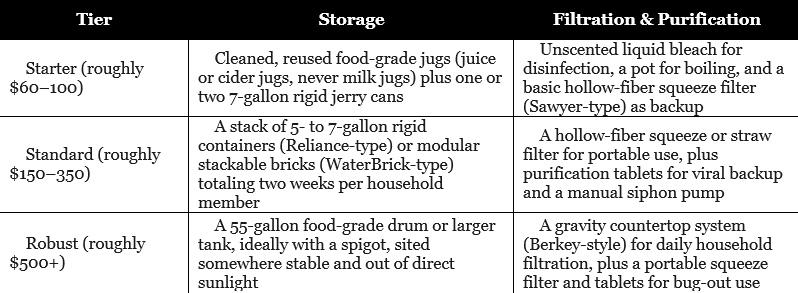
Whichever tier fits your household right now, the goal is not perfection on day one. It is having something in place before you need it, and adding to it steadily from there.
A Note for Readers Thinking Further Ahead
Most readers of this briefing live on municipal water in a suburban or urban setting, and everything above is built with that household in mind. But if you are among the readers who are thinking about moving toward more self-sufficiency over time, whether that is a piece of land with a well, rainwater catchment, or a fully off-grid homestead, the same three layers still apply, they simply scale up. A well needs a manual backup pump that does not depend on the electrical grid. Rainwater catchment needs a sediment pre-filter and, depending on your roof material, a first-flush diverter before water ever reaches storage. Off-grid households often add UV treatment as a fourth layer for daily use, on top of the storage, filtration, and purification described here. None of that is necessary to act on this week, but it is worth knowing the on-ramp exists if that is a direction you sense the Lord leading your household.
Why This Matters Beyond the Headline
“The wise man’s eyes are in his head, but the fool walks in darkness.”
- Ecclesiastes 2:14, NKJV
Preparedness of this kind is not fear. It is the ordinary stewardship Scripture consistently commends, the same posture behind Joseph storing grain years before the famine arrived, or a wise household keeping its lamp filled with oil before the bridegroom comes. Whether this particular wave of attacks traces back to Tehran, Beijing, or somewhere else entirely, the water your family drinks tomorrow should not depend on how that investigation turns out. Build the layers. Start with what you can afford this week, and add to it steadily.
We will return to water preparedness in greater depth in an upcoming article for The Joseph Strategy series over at The Faithful Remnant, which will build on the groundwork laid here and in last week’s briefing on the water system attacks themselves.
KNOW THE TIMES. HOLD THE LINE.
In each post there’s always the opportunity to subscribe for a free or paid subscription, but I know that a paid subscription may be a big ask in today’s economy so I also wanted to give you the opportunity to give a one-time gift to support this ministry. So if you don’t want to commit to a monthly or yearly gift of support but you still feel you have been blessed by something I’ve done here, I’ve come up with a new way to give a one-time gift of any amount. Just click the link below (or scan the QR code and you’ll be taken to the page for Know the Times).

And, as always, feel free to share this article with someone you feel may be blessed by it.